Single Blog
Good technical fabrics start from what the product must survive, rather than from a fabric catalogue. – Every requirement can be turned into a measurable property and a recognised test. – Bringing the fabric supplier in early is the cheapest way to avoid surprises at bulk scale.
A backpack strap that tears at the seam, a legging that pills after five washes, a bag that lets rain through on the first wet day. Each of these is a material problem that reaches the customer as a brand problem. Often the sample looked right and passed the hand-feel test in a meeting room, and the trouble only showed up once thousands of pieces were in production.
That is why the material has to be designed around the product, long before the first sample.
Technical textile development starts with the product requirement
Technical textile development is the process of turning a product’s performance needs, such as load, abrasion, water resistance and washing, into a measurable fabric specification. The specification covers fibre, yarn, construction and finish, is checked with recognised test methods and is confirmed on samples before bulk production.
Every technical fabric starts with a question about the product. What does it carry? Where is it used? How often is it washed? A school backpack takes a heavy load on one strap, gets dropped and dragged, is caught in rain and must keep its colour. An athleisure legging stretches with every movement, is rubbed at the thigh and is washed after every wear.
It helps to write down how the product fails, too. A backpack rarely fails mid-panel, and far more often fails at a strap anchor, at the base or along a seam that carries the load. A good brief also says what the product does not need. A school bag does not need the water resistance of a trekking pack, and leaving that out keeps the specification honest and the price sensible.
Turning requirements into a fabric specification sheet
Once the requirement is clear, it becomes numbers a mill can make and a lab can test. Mass per unit area (GSM) is the fabric’s weight per square metre, and ISO 3801 sets the method for woven fabrics. Denier is yarn fineness, which Britannica gives as “the number of grams of weight per 9,000 metres” of yarn. Construction covers weave or knit and yarn density. Coatings and finishes add water resistance or other functions.
Each property is then tied to a test method, so “strong” or “waterproof” becomes a number both sides agree on.
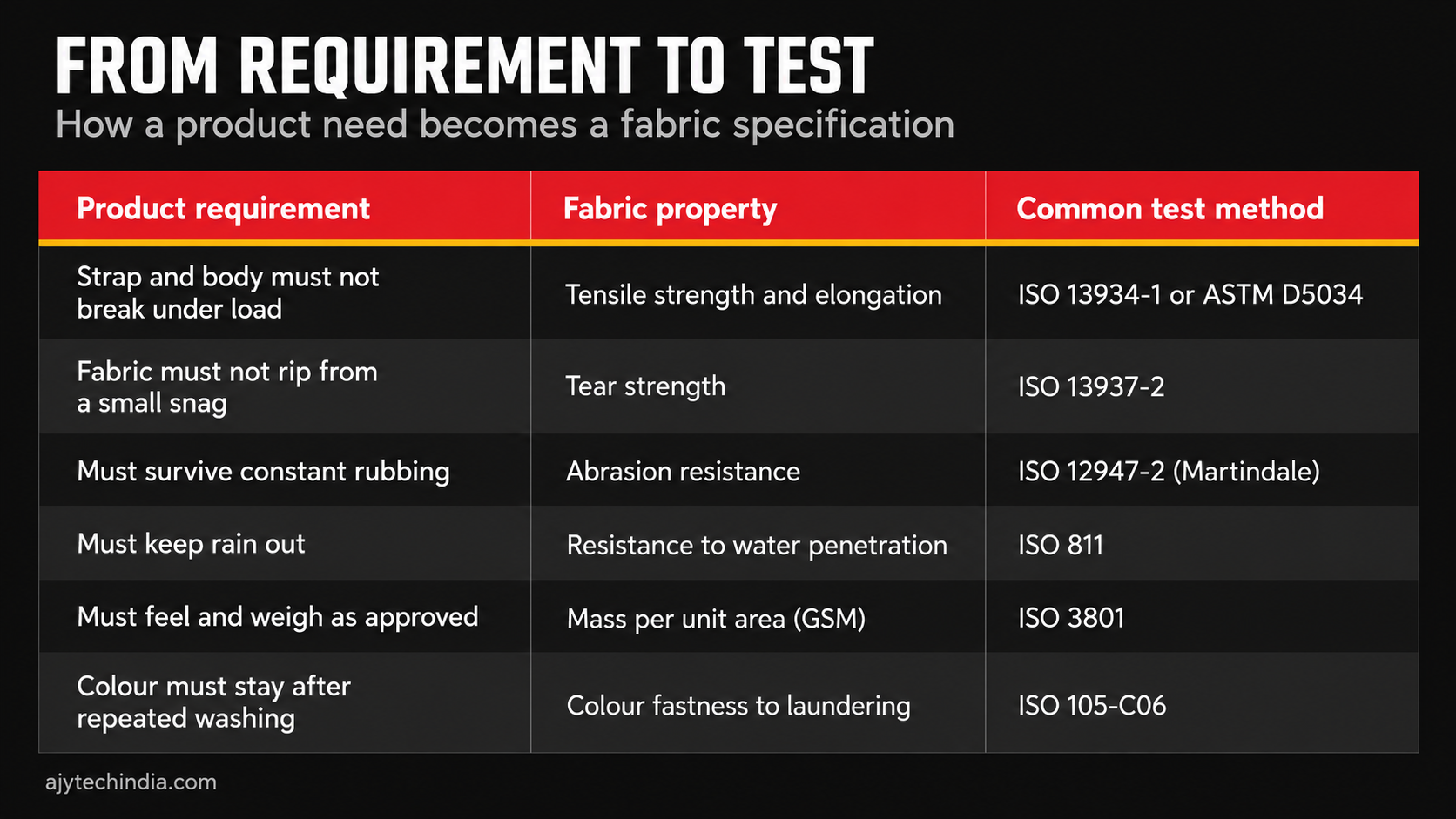
The fine print matters. ISO 13934-1 is not normally applicable to coated fabrics. ASTM D5034 is not recommended for fabrics with high stretch (more than 11%), which rules it out for most athleisure knits. ISO 12947-2 does not apply to coated or laminated fabrics, which have their own abrasion methods in ISO 5470. When choosing bag fabric testing standards for coated materials, picking the right method is part of the specification.
Balancing function, manufacturability and cost
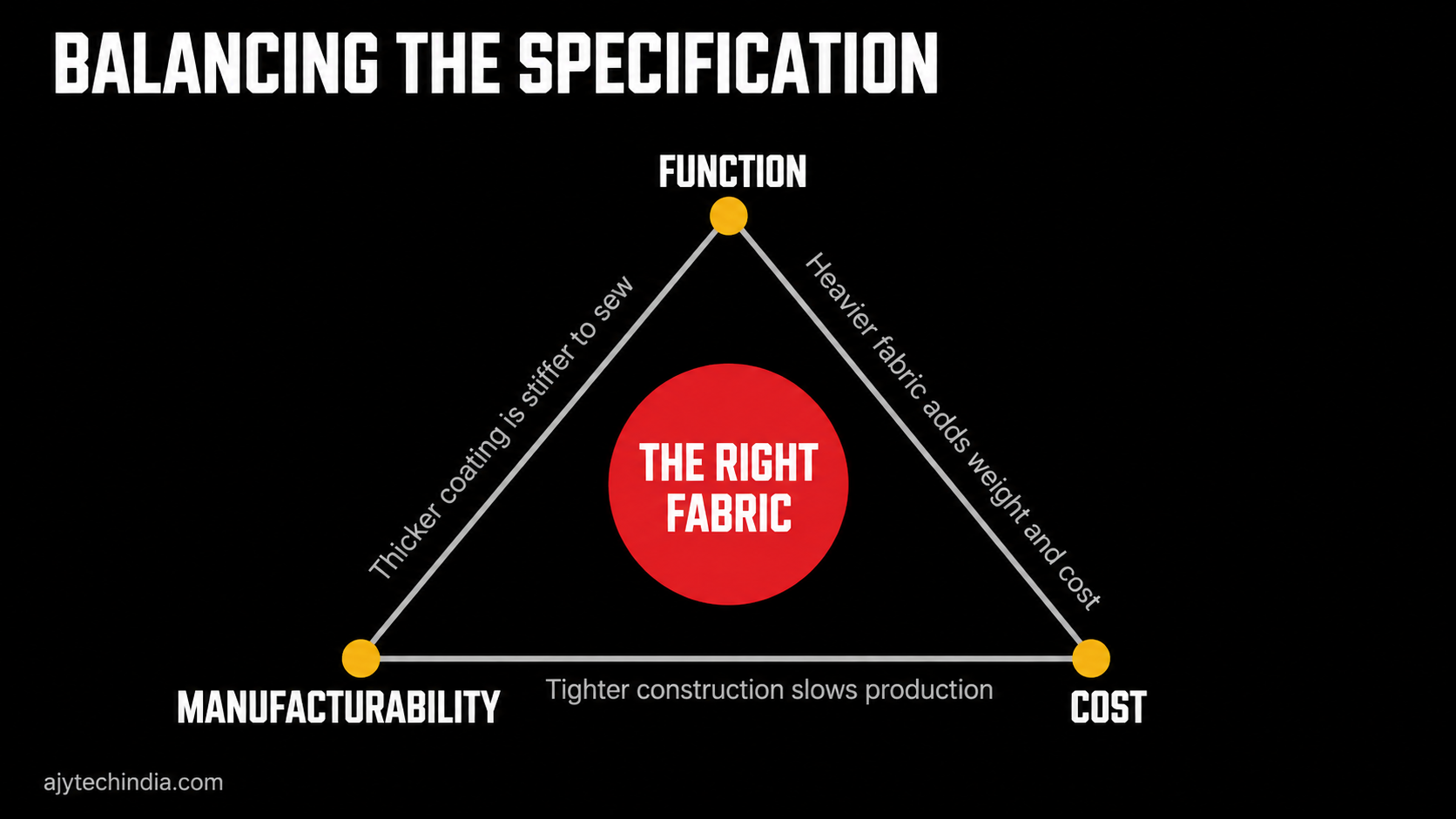
A specification can always be pushed higher, with a heavier, stronger or more water-resistant fabric. Every step up affects something else. A heavier fabric adds weight and cost. A thicker coating may make the fabric stiffer to sew. A tighter construction may slow production.
The goal is a fabric that meets the requirement with a sensible margin, runs well on the stitching line and fits the product’s price. That balance is found by testing options side by side, rather than by picking the most impressive number on a data sheet.
The role of product development and procurement
Product development owns the requirement. Procurement owns the commercial terms. Both need the same specification sheet.
When they work from different documents, the problem is predictable. Development approves a fabric on performance. Procurement finds a cheaper “equivalent” with the same GSM but a different construction. The test results don’t match, and nobody knows until production. A shared specification, with test methods and pass levels written down, stops that and gives both teams a fair way to compare suppliers.
From sample approval to scalable production
A sample proves the fabric can be made. Bulk production proves it can be made consistently. Between the two, a new yarn lot, a different dye batch or a coating line running at another speed can all shift the result. That is why bulk lots are checked against the same tests used to approve the sample, with agreed tolerances. A practical bulk-approval sheet covers these points.
- GSM and width, each with an agreed tolerance
- Shade against the approved standard, checked under the same light source
- The key performance tests from the specification, repeated on bulk lots
- Shrinkage after washing, since it affects both fit and cutting
This is where a perfect sample often goes wrong in bulk. The sample was right, but nobody agreed what “right” meant in numbers, so nobody could check that piece 5,000 matched piece one.
Why involving the supplier early reduces surprises
The earlier the fabric supplier sees the requirement, the more options are on the table. A supplier can suggest a construction that hits the abrasion target at a lower weight, or flag that a coating will not survive the planned wash cycle, before costing is fixed.
Brought in late, the supplier can only quote against a specification someone else wrote. Brought in early, it helps write one that can be delivered at scale, with fewer sampling rounds and lead times for special yarns or finishes planned from the start.
How AJY Tech, a technical textile supplier in India, develops materials
At AJY Tech India, we start where this article starts, with the product, its use and its failure points. Our weaving runs on water-jet looms handling yarns from 50D to 1000D. In coating and finishing we work with polyurethane, silicone, vinyl and acrylic coatings, and finishes such as water resistance (WR and DWR), flame retardancy, anti-microbial and anti-static treatments. Our R&D team develops prototypes and tests them before a fabric moves to bulk, and fabrics are inspected for consistency, defects and colour uniformity on the 4-point system.
For bag and athleisure fabrics, this means the specification is built around the product before the first sample is woven.
When the requirement is written down, the tests are agreed and the supplier is involved from the first sketch, the strap holds and the colour stays. Good material development goes unnoticed on the first day, and on the five-thousandth piece.
Developing a new product? Let’s build the material around it at ajytechindia.com
Frequently asked questions
What is the Martindale abrasion test? The Martindale abrasion test measures how well a fabric resists rubbing. ISO 12947-2 sets out how to find the point at which the specimen breaks down, by inspecting it at fixed intervals.
What does hydrostatic head mean for fabric? Hydrostatic head is the water pressure a fabric can withstand before water starts to come through it. It is measured with the hydrostatic pressure test in ISO 811.
What does denier mean in bag fabrics? Denier is the weight in grams of 9,000 metres of yarn. In bag fabrics, a higher denier means a heavier, thicker yarn.
Which tensile test is used for fabrics? ISO 13934-1 (strip method) is a common tensile test for woven fabrics, and ASTM D5034 (grab test) is used for many fabrics. ASTM D5034 is not recommended for fabrics that stretch more than 11%, such as most athleisure knits.
Sources
- ISO 13934-1:2013 Tensile properties of fabrics, Strip method · ISO
- ASTM D5034-21 Grab Test · ASTM International
- ISO 13937-2 Tear Properties, Trouser Specimens · Instron
- ISO 12947-2:2016 Martindale abrasion · ISO
- ISO 811:2018 Hydrostatic pressure test · ISO
- ISO 3801:1977 Woven fabrics, mass per unit area · ISO
- ISO 105-C06:2010 Colour fastness to laundering · ISO
- Denier system · Encyclopaedia Britannica


