

Single Blog
- Price per metre is only the starting point; the real number is the fabric cost per usable product.
- Usable width and marker efficiency decide how much of every metre becomes product and how much becomes offcut.
- When procurement and product development compare materials together, the cheaper fabric on paper is often not the cheaper fabric in production.
The purchase order looked like a win. Two fabric quotes, the same price per metre, and the team picked the one that could ship a day earlier. Three weeks later, the cutting master came back with a question nobody had asked at the costing stage: why was this fabric using so many more metres per bag?
The answer was on the cutting table. A slightly narrower usable width. Pattern pieces that no longer nested two-across. More offcuts in every lay.
Nobody had made a mistake on price. The mistake was looking only at price. That is the hidden cost of material waste in technical textiles.
Why purchase price hides the real cost of material waste in technical textiles
Material waste in technical textiles is the share of purchased fabric that never becomes part of a finished product: selvedges, unusable width, cutting offcuts, shrinkage allowances and rejected pieces. This is why the true material cost is the fabric cost per finished product, not the price per metre on a quotation.
A rate per metre is easy to compare. But a product is not made from metres. It is made from panels, cut from a specific width, in a specific layout, with some fabric always left over. The useful question is what the fabric inside one finished product costs, including what was thrown away to make it.
Fabric width and usable material
Fabric is sold at a stated width, but not all of it can be cut. Selvedges, edge variation and marks near the edge reduce the cuttable width, so two rolls with the same nominal width can give different usable widths.
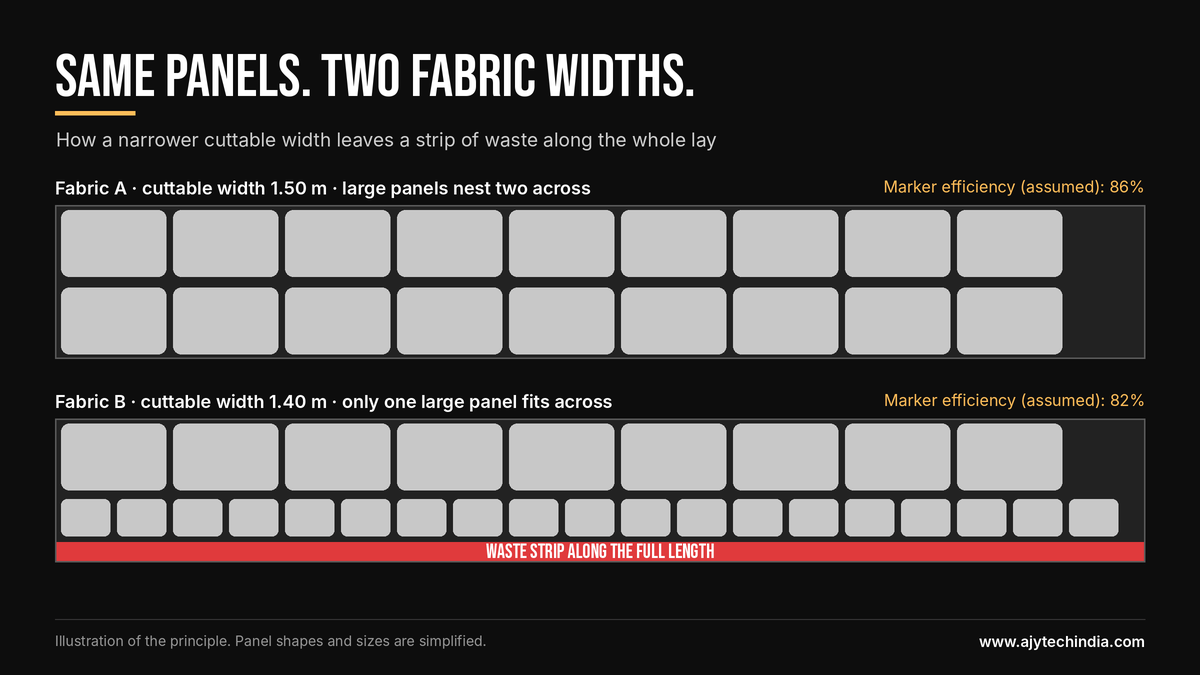
Width also decides how the pattern fits. Research on markers usually fixes the width before comparing anything else: a 2016 study in the International Journal of Textile Science used a 56-inch marker, and a 2026 study in the Journal of Textile Engineering & Fashion Technology used 58 inches. On the shop floor, a few centimetres can decide whether two large panels sit side by side, or one panel sits alone beside a strip of waste.
Cutting and conversion waste: the marker efficiency formula
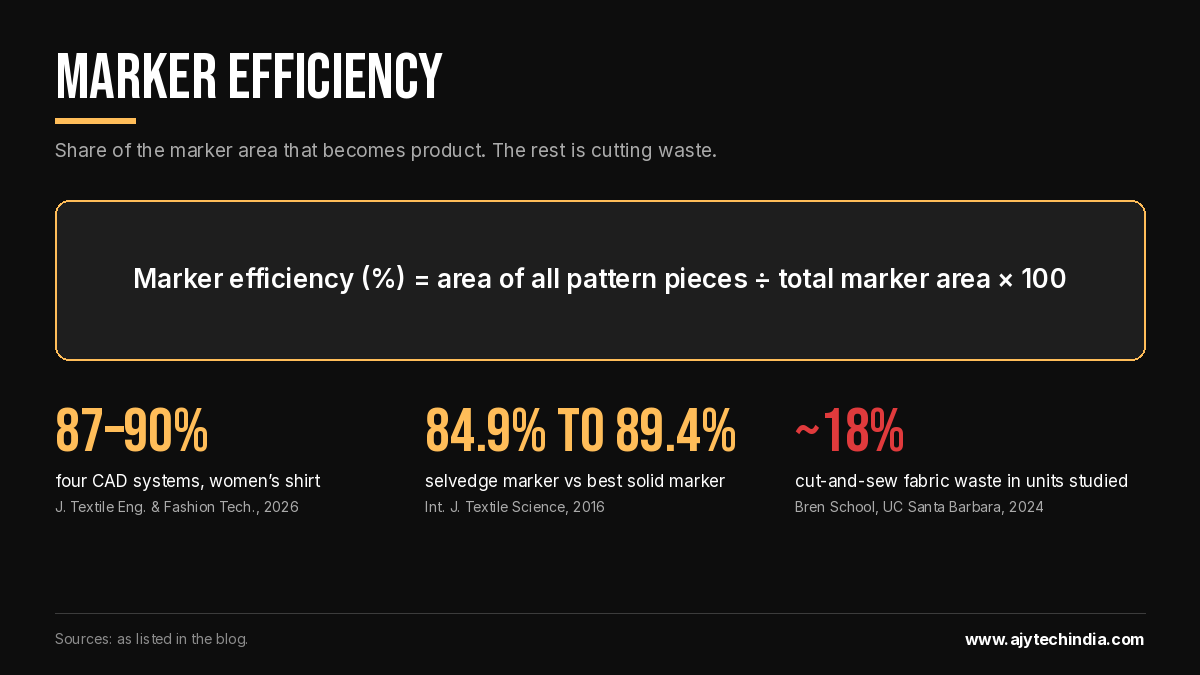
Some cutting waste is normal. The question is how much. Marker efficiency is the standard measure, defined in the 2026 study as “the percentage of fabric area occupied by pattern pieces compared to the total marker area.”
Marker efficiency (%) = area of all pattern pieces ÷ total marker area × 100
In that study, four CAD systems produced markers between about 87% and 90% for a women’s long-sleeve shirt. The 2016 study recorded 84.87% for a selvedge marker and 89.37% for its best solid marker. Across a supply chain, losses are larger. A 2024 report from the Bren School of Environmental Science & Management, University of California, Santa Barbara, cites older estimates that 10–15% of fabric is discarded in cut-and-sew, and calculated about 18% for the Tier 1 facilities it studied in Vietnam.
Technical products make this harder. Bag panels, straps, gussets and reinforcements come in very different shapes, and coated fabrics often need to be cut in one direction. Every constraint lowers the ceiling on marker efficiency.
Yield and product economics: a fabric cost per product calculation
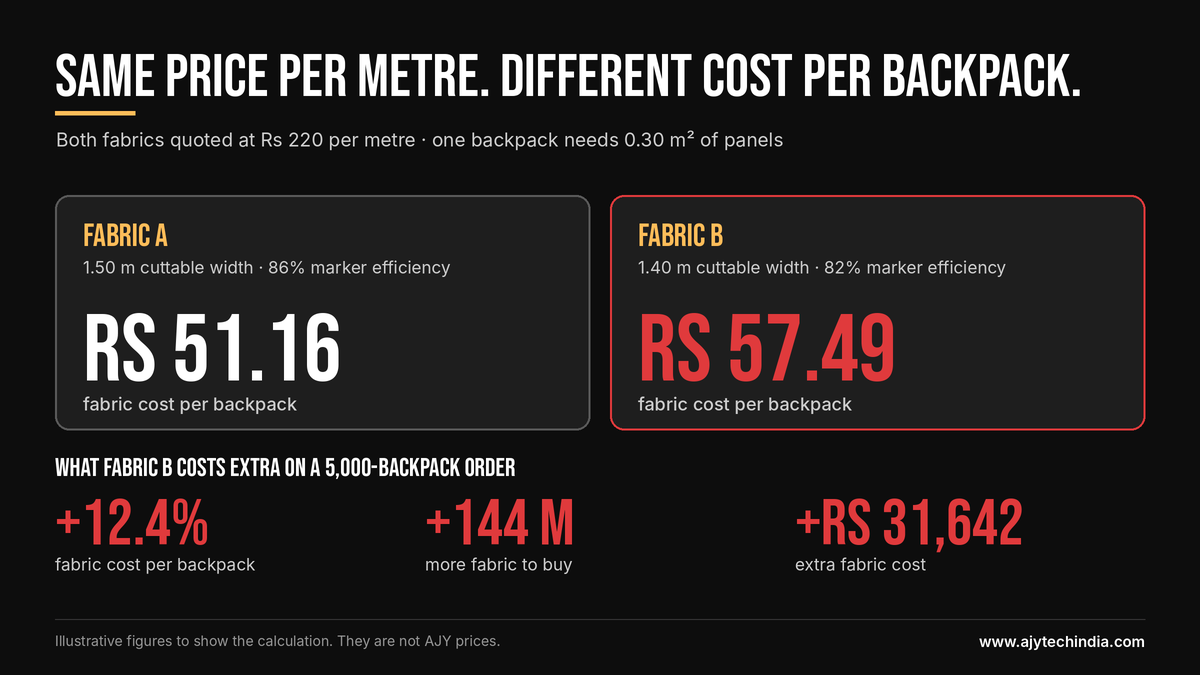
Here is a simple comparison for a backpack. The figures are illustrative assumptions, not AJY prices. Both fabrics cost Rs 220 per metre, and one backpack needs 0.30 m² of fabric panels. Fabric A has 1.50 m of cuttable width and reaches 86% marker efficiency. Fabric B has 1.40 m and, because the panels nest less well, reaches 82%.
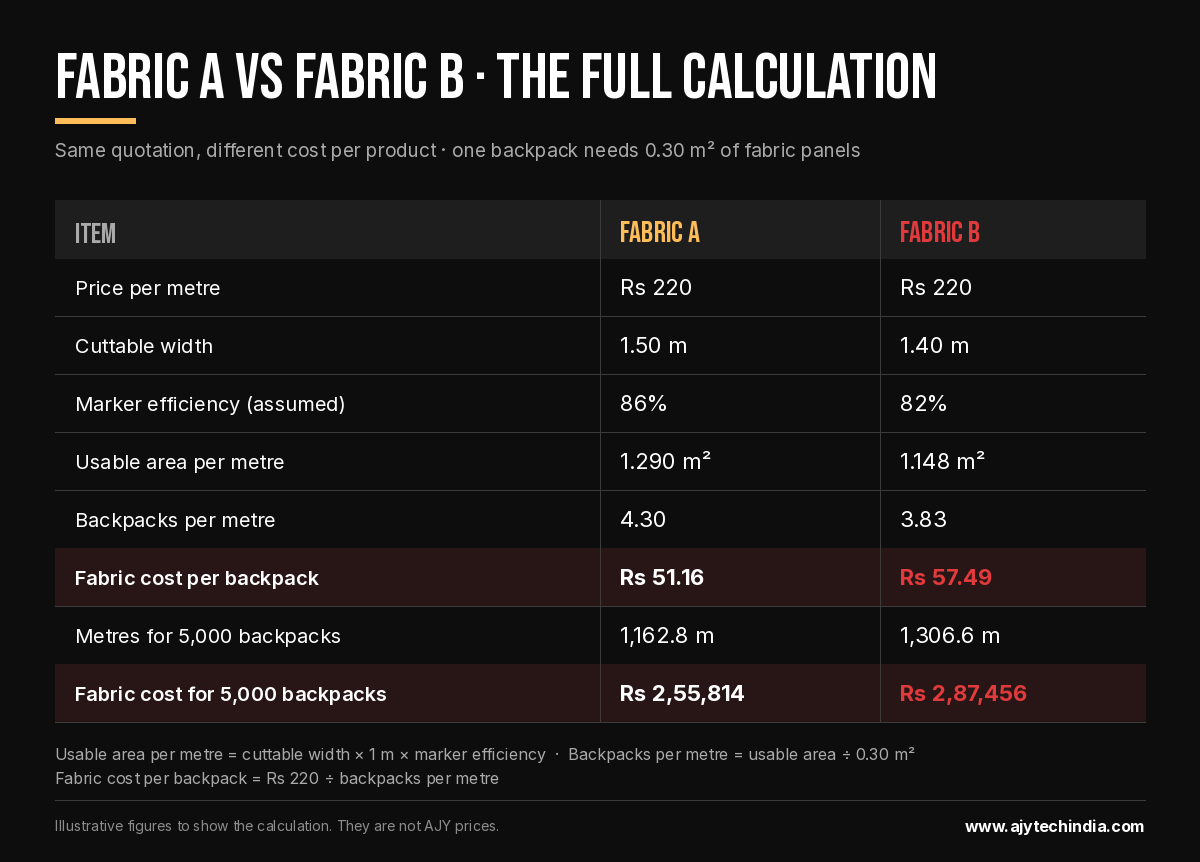
Same quotation. Fabric B costs Rs 6.33 more per backpack, about 12.4% more, and needs roughly 144 extra metres for a 5,000-piece order. That is Rs 31,642 of extra fabric before counting extra spreading, cutting time and waste disposal.
How material choices affect production efficiency
Waste is not only fabric left on the table. A roll with inconsistent width forces the cutting room to plan every lay for its narrowest point. Shrinkage that changes from lot to lot means extra margin everywhere, just to be safe; when shrinkage is known and stable, the allowance goes into the pattern once. In the 2026 study, all four CAD systems recorded slightly higher marker efficiency when a 3% shrinkage allowance was built in.
Shade variation between rolls stops pieces from different rolls being mixed in one product. A coating that marks easily means slower handling and more rejects. None of this changes the rate per metre. All of it changes the real cost.
Why procurement and product development should work together
In many companies, procurement owns the price, product development owns the specification, and the cutting room sees the result of both, usually last. A few questions before the purchase order change that:
- What is the usable width, roll to roll, not just the nominal width?
- What is the expected shrinkage, and how much does it vary between lots?
- Can the fabric be cut in both directions, or only one?
- How many pieces does the current marker give per metre on this fabric?
Then compare fabrics on cost per usable product, run a trial lay before a bulk order and share the marker with the supplier. A supplier asked only for a rate competes only on rate. A supplier shown the product and the marker can suggest a width or construction that cuts better, which is often worth more than a small discount per metre.
How AJY Tech, a technical textile supplier in India, approaches material comparisons
AJY Tech India started in Surat in 2011. We make technical textiles for bags and luggage (PackTech), athleisure, outdoor shelters (BuildTech), automotive interiors (ClothTech) and protective wear (ProTech). Our facilities cover weaving on water-jet looms for 50D to 1000D yarns, dyeing, coating and finishing, and every fabric is inspected for consistency, defects and colour uniformity on the 4-point system.
When a buyer compares materials, we look at the fabric as part of the product it will become: the width it is delivered in, how it cuts and how it runs in production. Our certifications, including OEKO-TEX Standard 100, GRS, Higg FEM and Sedex, cover what goes into the fabric; the comparison above covers what comes out of it.
Back in the cutting room, the cutting master is not looking for someone to blame. He is looking for the extra metres. Next time, he says, show him the width before the price. It is a small request, and the cheapest saving any product will ever get.
Planning your next material comparison? Talk to us – ajytechindia.com
Frequently asked questions
What is marker efficiency in garment and bag manufacturing?
Marker efficiency is the percentage of the marker’s fabric area that is covered by pattern pieces. The rest becomes cutting waste.
How much fabric is wasted in cutting?
Older estimates put cut-and-sew fabric waste at 10–15%. A 2024 University of California, Santa Barbara (Bren School) report calculated about 18% for the Tier 1 facilities it studied in Vietnam.
Why does fabric width affect fabric cost per product?
Fabric width decides how pattern pieces fit across the fabric. A narrower usable width can leave unusable strips, which lowers marker efficiency and raises the fabric cost of each finished product.
How should two technical fabrics be compared on cost?
Compare them on fabric cost per finished product, using usable width, marker efficiency and expected losses, rather than on price per metre alone.
Sources
- Examining Cut-and-Sew Textile Waste within the Apparel Supply Chain (2024) – Bren School, UC Santa Barbara
- The impact of fabric shrinkage percentage on marker efficiency – Journal of Textile Engineering & Fashion Technology (2026)
- Impact of Different Sorts of Marker Efficiency in Fabric Consumption – International Journal of Textile Science (2016)


